


Amazon revealed at its unBoxed advertising event — later reported by Advanced Television — that its ad-supported Prime Video tier now reaches 315 million monthly viewers across 16 global markets, signaling one of the fastest shifts toward ad-driven streaming in the industry.
The metric, described as an “average monthly active ad-supported audience,” includes viewers of:
- Prime Video subscription content
- Amazon Originals, movies, and licensed TV shows
- Live sports
- Free ad-supported live channels, including Freevee (FAST)
Ads are now the default experience.
Earlier this year, Amazon changed Prime Video to ad-supported by default, requiring subscribers to pay extra to remove ads. Amazon did not disclose the percentage of subscribers who opted into ad-free viewing, but multiple analyst groups estimate less than 5% of Prime Video subscribers are currently paying the upgrade fee.
That default flip puts Amazon into a different category than other streamers—instead of discounting into an ad tier, Amazon is monetizing the entire base.
Netflix also shared new ad-tier metrics, stating that its ad-supported tier now reaches 190 million monthly active ad viewers. Netflix uses a newly introduced “Monthly Active Viewers (MAV)” metric, defined as subscribers who have watched at least one minute of ad-supported content within a given month, adjusted for household viewing.
Meanwhile, YouTube remains the dominant ad-supported video platform, reporting more than 2 billion logged-in monthly viewers on connected TVs alone, and fewer than 5% of users pay for Premium.
Benchmark: Ad-Supported Streaming Reach
(Different platforms report different types of activity—viewer reach, ad-tier subscribers, or % mix.)
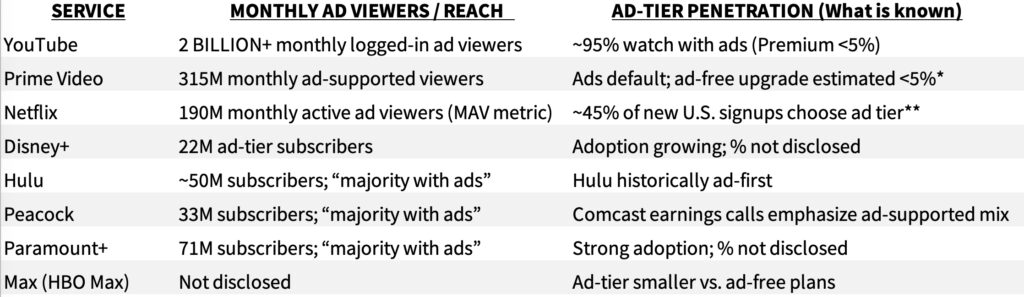
* Amazon ad-tier upgrade estimate based on analyst consensus; Amazon does not disclose.
** Netflix discloses % of new signups choosing ad tier; not %, of total subscribers.
*** While Amazon, Netflix, and others report how many viewers see ads, only a few disclose how many subscribers intentionally choose the ad-supported tier.
****Based on earnings calls and analyst estimates, ad-supported subscriptions now represent between 40–75% of subscriber bases across most major streaming services.
WHAT INDUSTRY ANALYSTS ARE WATCHING
Executives and analysts watching these numbers are focused on three gaps:
-
Different metrics, not comparable.
Amazon reports reach. Netflix reports ad-viewing subscribers.
Others only report ad-tier subscriber counts.
There is no standard definition for “ad-supported audience.” -
Amazon’s number includes free inventory.
Prime Video’s 315M count includes Freevee/FAST viewers—not just Prime subscribers. -
Viewers ≠ profitability.
Netflix has publicly said its ad tier generates higher ARPU than the Standard plan,
but no platform has disclosed margin contribution.
Rather than questioning the data, analysts are questioning the business model efficiency behind the data.
WHY THIS IS HAPPENING NOW
Three strategic forces are driving the shift:
-
Margin pressure
Content costs, sports rights, and production inflation make pure subscription margins unsustainable. -
Subscriber growth has plateaued
North America has hit subscription saturation. Ad tiers slow churn. -
Ads now outperform subscription revenue
Netflix says its ad-tier subscribers produce higher ARPU than its Standard plan.
Ads aren’t a cheaper version of streaming.
Ads are the more profitable version of streaming.
INSIDER TAKE
Streaming is no longer a subscription business — it’s an audience monetization business.
Key takeaways for subscription executives:
-
Reach is a key KPI.
Subscriber totals are no longer the headline metric on earnings calls. -
Ad tiers are pricing fences.
They allow you to profitably segment price sensitivity without discounting the product. -
Portfolio monetization beats single SKU.
The most successful subscription companies are shifting from “a subscription” to
a portfolio of revenue paths: ads + subscription + upsell.