Source: New York Times

It’s been two weeks since the presidential election with Republican candidate Donald Trump winning the presidency over Democrat Hillary Clinton. Though votes are still being counted across the country, as of November 21, USA Today reports that Clinton leads the popular vote by about 1.7 million votes. Trump, however, has the required number – 270 – of electoral votes to seal the win for the Republicans. Since the election, the country has been polarized with half the voters thrilled about the country’s new direction and the other fearful of what’s to come.
Regardless of where you fall on the political spectrum, we have learned one thing from this election – our country wants and needs change, and voters are more engaged than ever in the political conversation. They want to know what’s going on, and they are turning to trusted news outlets to provide them with that information. Recent subscription figures from the New York Times, the Wall Street Journal and the Boston Globe bear that out. Let’s take a look at how their numbers have changed in the wake of the election.
The New York Times: Despite president-elect Donald Trump’s assertion that The Times is “losing thousands of subscribers,” the New York Times is alive and well. In fact, according to KTVQ, the New York Times added 41,000 paid subscriptions – print and digital combined – in the week following the election. According to KTVQ, executive editor Dean Baquet said the surge in subscriptions is due to the newspaper’s “strong aggressive coverage and scoops.” In an interview with CNNMoney, Baquet said, “It pays to do real news at a time when there is so much fake news around.”
Source: Twitter

In addition to the post-election increase, the New York Times had more than 100,000 net new subscribers in the fall quarter and record traffic on Election Day and the two days following it.
Along with its editorial coverage, the New York Times employed two other strategies which may have contributed to its recent subscription success. The news organization brought down its paywall during critical hours before and after the election, giving readers unlimited access for 72 hours from 12:01 AM Eastern on Monday, November 7 until 11:59 PM on Wednesday, November 9.
“This is an important moment for our country,” said Arthur Sulzberger, Jr., publisher of The New York Times. “Independent journalism is crucial to democracy and I believe there is no better time to show readers the type of original journalism The New York Times creates every day.”
The New York Times also hosted Election Night Live, a $250-per-person live event that included live commentary on election night results as well as hot topics of the day from New York Times’ editors, reporters and columnists, as well as special guests. By dropping the paywall, the New York Times took the opportunity to make its journalism more accessible. By hosting the event as part of its live conference series, the Times took the opportunity to more deeply engage with readers.

Source: The Wall Street Journal
Wall Street Journal: Unlike the New York Times, the Washington Post and the Los Angeles Times, the Wall Street Journal kept its paywall up during the election cycle, hoping to grow digital subscriptions, says Benjamin Mullin of Poynter. Though the paywall remained up, non-subscribers could still take advantage of the new 24-hour guest pass that allows readers to visit WSJ.com for articles, an initiative it began testing in August.
“Call me old-fashioned, but if your business model is to say ‘we are a paid-for, subscription-driven business,’ changing your mind willy-nilly is not a consumer-focused decision,” said Katie Vanneck-Smith, Chief Customer Officer and Global Managing Director of Dow Jones said in the Poynter article.
A week after the election, Dow Jones, Wall Street Journal’s parent company, shared the following statistics:
- WSJ.com on November 8 and 9 had the highest volume of unique visitors since February 2014, representing a 45 percent increase, in spite of the paywall.
- New subscriber volume was up 300 percent compared to an average Wednesday.
- New subscriber volume was up 160 percent across November 8 and 9 compared to normal.
- Visits from social media channels was up 38 percent.
- Organic search yielded 215 percent more traffic than normal.
Vanneck-Smith said the increase in subscriptions might be due, in part, to the fact that the Journal did not endorse a candidate for president.

Source: The Boston Globe
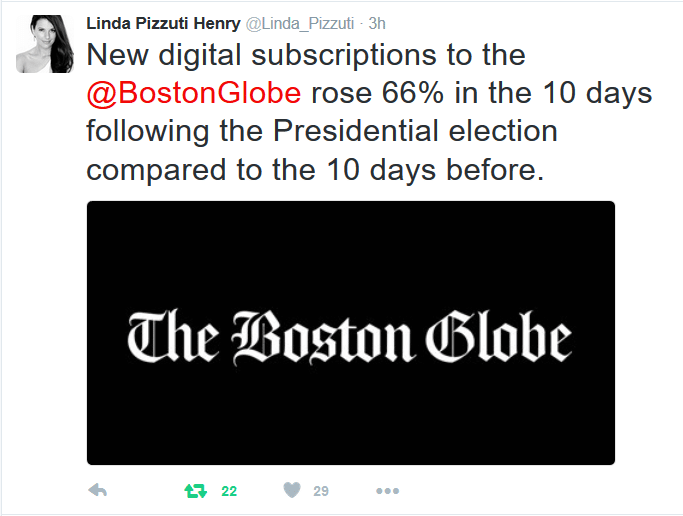
Boston Globe: Yesterday Linda Pizzuti Henry, managing director at Boston Globe and wife of owner John Henry, tweeted that new digital subscriptions rose 66 percent in the 10 days following the presidential election, compared to the 10 days prior.
Media critic and journalism professor Dan Kennedy shared the same information on Monday which came from a memo written by Mike Sheehan, chief executive officer of Boston Globe Media Partners, promoting Pete Doucette to the position of chief revenue officer. In the memo, Sheehan said the Boston Globe now has more than 72,000 digital-only subscribers which, he says, is the number one digital subscription business of any metro daily publisher, behind the New York times and the Washington Post.
Source: Twitter

In March 2014, when the BostonGlobe.com had a paywall, it had 60,000 digital-only subscribers. The site now has a metered paywall, allowing readers five free articles per month.
Insider Take:
Each of these major news organizations has a slightly different model. Each handled the presidential election a bit differently, yet each had its own form of success based on a variety of factors. What can other publishers learn from their examples?
- Know your readers and what will draw them in.
- Engage your readers and meet them where they are, whether it is on your site, in person or via social media.
- Define your business model and exceptions to it, so you have a playbook to draw from. For example, WSJ.com stuck to its guns and kept the paywall up which didn’t seem to hurt it at all. The New York Times, on the other hand, put the needs of its readers first, understanding that if they shared their quality work that some readers would convert into subscribers.
- Understand that some readers are willing to pay for quality work and unique journalism they don’t believe they can find elsewhere.