AI is moving deeper into pricing, payments, fraud, customer accounts and the basic mechanics of recurring revenue.

Signal of the Week:
AI is becoming an operating issue across pricing, payments, account security and customer authorization.
We did not start this week expecting to cover quite this much AI.
We had no choice.
Cue the background music: Aerosmith’s “Train Kept A-Rollin’.”
If you are still trying to figure out what AI might mean for your subscription business, the train is not waiting for you.
Payment networks are working through technical standards for AI-agent transactions. Companies are testing new pricing models. Enterprise buyers are re-evaluating AI vendors quickly. Fraud is showing up in paid usage. AI is moving into places subscription operators already manage every day.
And that was just this week.
What caught our attention is where all of this is landing: pricing, payment authorization, account security, vendor decisions, usage and customer value. Familiar operating territory, with new AI questions dropping into the middle of it.
The companies making the headlines may be large, but these operating questions are not limited to them. The AI train is headed toward small subscription businesses too.
Stories Behind This Week’s Signal
The Card Networks Are Already Designing for AI Agents
American Express, Discover, JCB, Mastercard, UnionPay and Visa jointly own EMVCo, the technical body that helps develop standards for card payments. It is now working through how AI agents could make purchases for consumers, including purchases that happen again later. For subscription operators, the technical framework is secondary.
The question underneath it is very familiar: what did the customer authorize, and does the next purchase still fall within that permission? The customer may not be at checkout. Permission still has to be.
OpenAI: When the Billable Unit Starts Moving
OpenAI is reportedly giving some large customers the option to pay when AI completes agreed work rather than simply for access or usage. As AI takes on more of the work itself, seats and consumption do not always line up neatly with value. Companies are now testing whether the thing customers pay for should be access, usage, completed work or the result itself.
AI is changing the product. It may change what goes on the invoice too.
Meta + Salesforce: When the Subscription Still Needs a Meter
Meta is packaging Muse Code as monthly plans with defined usage allowances. Salesforce is taking another version of the same idea into the enterprise market. Its new Agentforce editions bundle AI into broader software packages while including Flex Credits that meter AI use.
Very different products. Same underlying problem. The recurring price gives customers more predictability, while the meter helps protect the provider when AI consumption keeps climbing.
AI may fit inside the subscription. Unlimited usage often does not.
Read more (Meta)→
Read more (Salesforce)→
Enterprise AI Buyers: The Customer May Still Be Shopping
AI budgets are growing, but the vendor decision appears far from settled. Madrona’s enterprise research found that 77% of companies re-evaluate their AI vendors at least every six months. That turns the AI boom into a retention question too. How do you keep proving enough value to stay when customers expect to revisit the technology decision again and again?
Winning the AI customer may only buy you six months to win them again.
Anthropic: When Usage Becomes Something Worth Stealing
Stolen Claude sessions were used to consume usage belonging to paying customers, leading Anthropic to refund unauthorized charges. That is what makes this bigger than an account-security story. When usage carries monetary value, someone can consume something the subscriber has already paid for. If additional paid usage is enabled, the financial exposure can grow from there.
When usage has a dollar value, fraud can drain the subscription before another charge ever appears.
Also on the Radar
Growth & Retention
- Oura Says More Than 94% of Ring Activations Convert to Paid Membership
The ring does useful work on its own, but the membership unlocks much more of the data, insight and guidance. That gives Oura a clear answer to why a hardware buyer keeps paying after buying the hardware.
Read more → - eDreams Prepared Investors for Prime Shift. Shares Still Fell 16%
eDreams ODIGEO is the European travel group behind eDreams, Opodo and other travel brands. Its Prime travel membership has grown to 8.1 million members, making the subscription central enough to the business that eDreams is willing to accept near-term pressure to keep building it. Now it has to prove that the long-term member economics justify the investment.
Read more →
Pricing & Monetization
- Apple-Peacock Bundle Price Rises, Savings Still Top 30%
The bundle got more expensive without losing its reason to exist. Customers who want both services can still see a meaningful financial advantage to buying them together.
Read more → - IPSY Turns Its Membership Into a Marketing Business
Membership can create assets beyond the recurring fee. IPSY is now trying to earn additional revenue from the audience, feedback, reviews and product-testing capability its member relationships created.
Read more → - Subscription Spending Rose 7.7% Year Over Year, BofA Says
A bigger subscription-spending number is useful, but it is not an explanation. Higher prices, more subscriptions and changes in what consumers buy can all make the top line rise.
Read more →
Strategy & Operations
- Dollar Shave Club Buys Truly Beauty in First Acquisition
Dollar Shave Club plans to share capabilities behind the scenes while keeping the brands and customer experiences separate. The useful operating question goes well beyond M&A: what should you share because it creates scale, and what should stay different because the customer values the difference?
Read more → - USPS Plans Holiday Package Rate Increases Averaging 6%
A modest increase on one package looks different when it is multiplied across thousands of subscribers and repeated shipments. For physical subscription businesses, shipping increases are recurring-cost increases.
Read more →
Compliance & Subscriber Trust
- Japan Panel Proposes Ban on Blocking Subscription Cancellations
The details differ from market to market, but the direction keeps repeating. Regulators are paying closer attention to what happens after a customer decides to leave, making cancellation an increasingly cross-market operating issue.
Read more →
Question for Your Team
Where is AI already touching your subscription operation, and have you decided what rules it should follow there?
How much revenue are you losing in the handoffs between systems, teams and workflows?
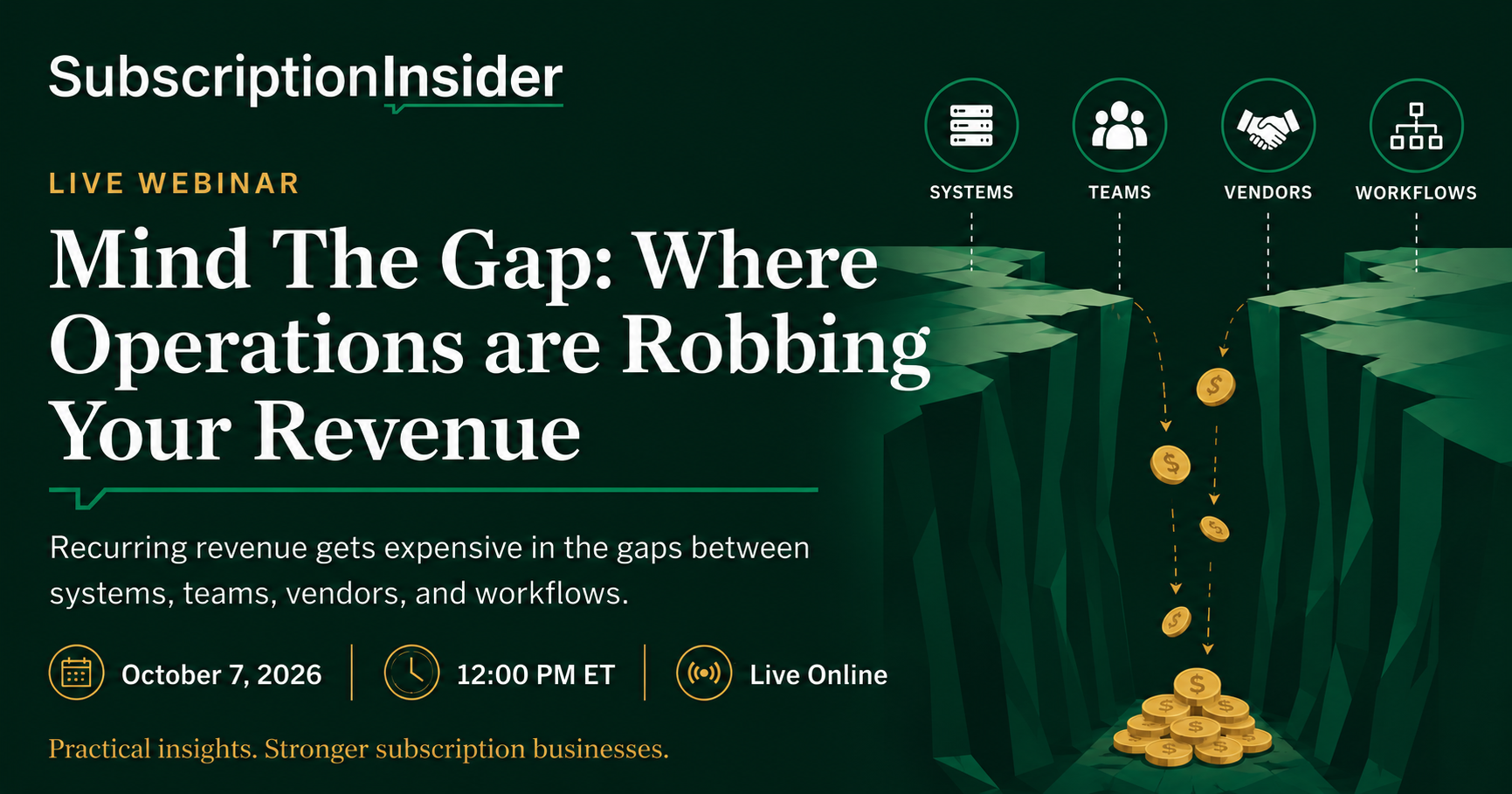
Learn where to look first on October 7 →
Go Deeper in the Member Center
For Subscription Insider members, this week’s Signal connects especially well to our new resource, Is Your Recurring Payment Authorization Set Up Correctly?, which looks at recurring payment indicators, stored credentials, transaction timing, original transaction linkages, retry windows, routing and other setup decisions that can affect approvals and revenue.
As AI agents begin entering the payment flow, understanding how recurring authorization works today becomes even more useful.
Also new this week:
- Connecticut Generative AI Subscription Disclosure and Acceptance Brief
- Subscription Box Fulfillment: 10 Decisions to Understand Before You Ship
- What Is a 3PL, and What Does It Actually Do?
- Subscription Vendor Deal Tracker: August 2026
We also updated the Subscription Regulatory Monitor, Enforcement, Litigation & Risk Activity Tracker, and Mastercard Brief for Subscription Businesses with new developments.
A Subscription Insider membership gives you instant access to analysis, decision tools, and practical resources built for subscription, membership, and recurring-revenue leaders. Learn more →
That's it for this week,
Kathy