T-Mobile Rethinks How Subscription Benefits Are Sold
Oct 27, 2026New T-Mix plans give wireless customers more choice over subscription benefits, while offering participating providers three months of guaranteed revenue for each selection.
T-Mobile is giving wireless customers more choice over the subscriptions included in their plans. Instead of accepting a fixed package of benefits, customers will be able to select services such as Netflix, Apple Music or Xbox Game Pass, then change many of those choices every three months.
For subscription businesses, this creates another way to reach customers through a company they already pay each month. T-Mobile is also offering participating providers at least three months of revenue for each selected benefit, giving them some predictability even as customers gain more freedom to switch services.
Announced October 26 and scheduled to launch in November, the new T-Mix plans are another example of how telecom companies are changing the way they package and sell subscriptions from other providers.
How T-Mix Works
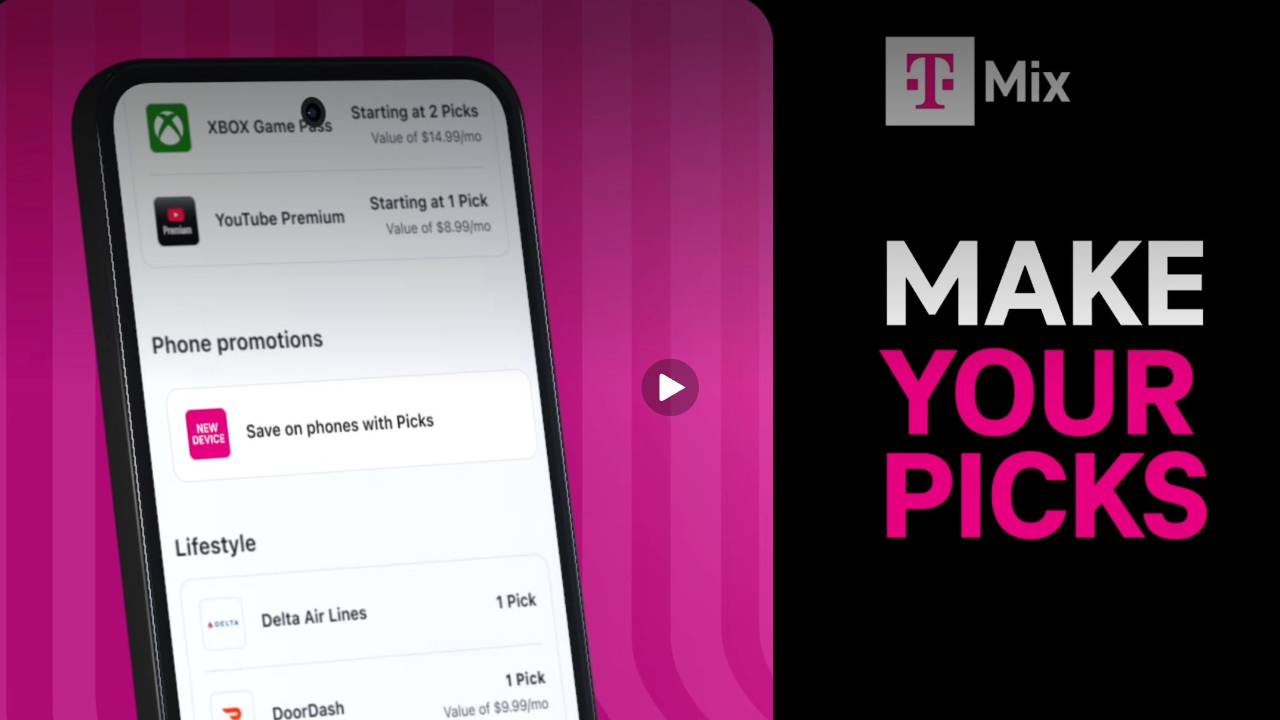
T-Mobile is introducing credits called Picks, which customers can use toward subscriptions, wireless features or phone promotions.
Its three plans start at $55, $75 and $95 per month for one line, with AutoPay, plus taxes and fees. They include one, two and three Picks, respectively. Adding phone lines increases the number of Picks available across an account.
Different services require different numbers of Picks. Netflix Standard with ads uses one, while ESPN Unlimited requires four. A customer with a single phone line wouldn't have enough Picks for ESPN Unlimited, even on the highest-priced plan.
Customers can generally change their subscription benefits during quarterly selection windows without changing their wireless plan. Someone who wants Netflix for a particular series could switch to another service a few months later.
There are limits to that flexibility. Phone promotions use the same pool of Picks, but those credits can remain committed for the length of a device agreement, commonly 36 months. T-Mobile can also change which benefits are available and how many Picks they require.
Some customers may find they're making trade-offs between phone promotions and subscription benefits that previously came together. Whether the new arrangement offers better value will depend on how each household uses its plan.
Another Approach to Flexible Subscriptions
T-Mobile isn't the first telecom company giving customers more control over subscription bundles.
In August, Austria's A1 introduced A1 Select, which lets customers purchase subscription slots for €6.90 per month and fill them with participating digital services. Some services cost extra. Customers can choose a different service each month, with the change generally taking effect at the end of the current billing period, without canceling the slot itself.
Subscription Insider covered A1's launch in August because of its approach to keeping the subscription relationship while allowing the service inside it to change.
T-Mobile's model works differently. Benefits are included in the wireless plan, but most partner subscriptions can only be changed during quarterly windows. Customers can also spend their Picks on phone promotions, something that isn't part of A1's subscription-slot model.
A1 gives customers more frequent opportunities to switch services. T-Mobile combines subscription choices with other wireless benefits and longer commitments.
Both approaches allow customers to change what they're receiving while keeping their main relationship with the telecom provider.
What Subscription Providers Get
For participating companies, T-Mobile offers a way to reach customers who may prefer to receive services through their wireless plans rather than manage another subscription separately.
T-Mobile Chief Marketing Officer Allan Samson told Fierce Network that the company guarantees participating providers at least three months of revenue for each selected benefit. That gives providers some certainty about revenue during the period before a customer can make another selection.
According to GeekWire, T-Mobile negotiates access to participating subscriptions below their regular retail prices. The company hasn't disclosed the payment terms for individual providers, so we don't know how much they earn per subscriber or how those payments compare with direct subscriptions.
T-Mobile has been testing the program in 37 Kansas City-area stores since October 1. Samson told Reuters that Netflix was the most popular choice, with music, AI subscriptions and Xbox gaming also attracting interest.
The early results don't establish whether customers are discovering new services or simply moving subscriptions they already have into their wireless plans. It will take more time to see how often customers switch and which services they keep.
The Work Behind the Changes
Making the new model possible has required T-Mobile to change its own systems.
Samson told Fierce Network that the company eliminated approximately 1,500 older plan codes this year, reducing the number of existing arrangements its technology teams had to support.
That effort followed a difficult transition for some longtime customers. When T-Mobile moved people from older plans to newer ones, some lost promotional discounts or encountered billing errors. The company acknowledged technical problems affecting a small number of accounts and said it was working to correct them.
T-Mix brings its own customer-service questions. People who already subscribe directly to a participating service may need to manage that subscription separately to avoid paying twice.
When customers change their Picks, access to the previous service needs to end as expected, and the new one needs to begin without confusion. The choices may be simple to make in an app, but managing them across different providers takes more work.
INSIDER TAKE
We've now seen two telecom companies give customers more freedom to change subscription services while keeping their main account.
Austria's A1 allows customers to change services every month. T-Mobile generally uses three-month windows and guarantees participating providers revenue for that period. We don't know enough about A1's partner agreements to compare which arrangement offers better economics for the companies supplying the services.
For customers, the appeal is understandable. They can choose services that fit what they want now, rather than continue paying for benefits they rarely use. How much flexibility they actually have, and whether they're getting a better deal, depends on the plan and its restrictions.
For subscription companies, the calculation is more complicated. A telecom partner can bring customers and manage the main billing relationship, but it also influences which services customers see and when they can move to something else.
T-Mobile's three-month revenue commitment gives participating providers something useful. What we don't know is how much those subscribers will be worth compared with direct customers, or whether they'll remain after their next opportunity to switch.
Subscription providers considering arrangements like these have some important questions to answer. How many genuinely new customers will the partnership bring? What will they earn from those subscribers? And how much control will they have over the ongoing customer relationship?
A1 and T-Mobile are taking different approaches. Their results should give the industry a better understanding of what customers want from flexible bundles and how these arrangements work for the subscription businesses supplying them.
Related Member Resources
T-Mobile's three-month revenue commitment gives subscription partners some certainty, but it doesn't tell them what those customers will be worth over time. There's also the question of who controls the subscriber relationship when customers can switch services through another company. These resources help operators examine both sides of a potential bundle partnership.
- Subscription Partner Bundles: How to Evaluate Revenue Quality
This strategy guide helps operators assess what a partner bundle actually earns, how its subscribers behave and whether the revenue holds up over time. It's useful for examining whether T-Mobile's three-month commitment translates into worthwhile business once customers can switch to another service.
- Subscription Bundle Partner Selection Guide
This guide helps teams evaluate a potential bundle partner and work through questions about billing, customer data, account access and support responsibilities. Those questions become especially important when a telecom provider decides which subscriptions customers can choose and when they can change them.
SOURCES
-
T-Mobile: T-Mobile Shakes Up Wireless Again with First-Ever T-Mix, October 26, 2026
-
Reuters: T-Mobile Debuts Wireless Plans With Customizable Perks, October 26, 2026
-
Fierce Network: T-Mobile's Next Un-carrier Move, October 26, 2026
-
Ars Technica: T-Mobile Bungled Forced Plan Migration, July 16, 2026
Reported by: