The Guardian Turns Account Sharing Into a Subscription Benefit
Oct 20, 2026The Guardian is letting eligible subscribers add three individual accounts, while The New York Times has taken a different approach by charging more for family access.
The Guardian is making it easier for paying readers to share their subscriptions without sharing a password.
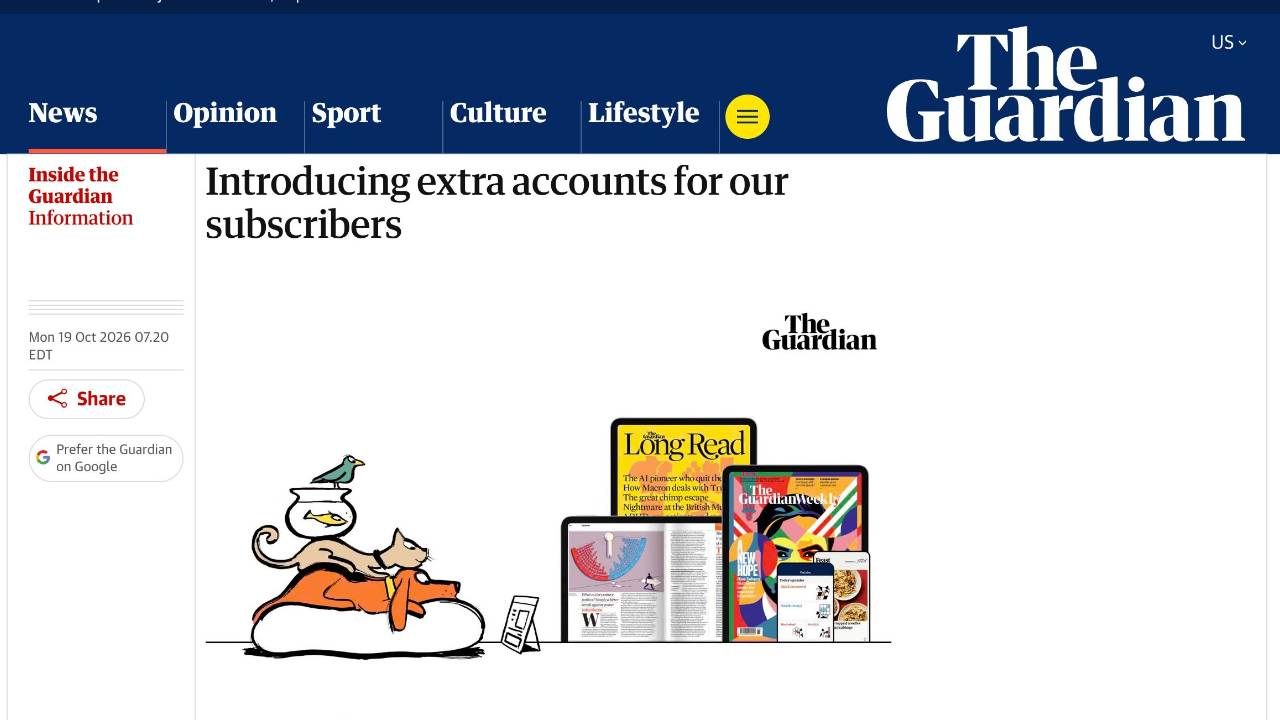
Announced October 19, its new Extra Accounts feature allows Digital Plus and qualifying print subscribers to invite up to three other people, each with a separate login and personalized experience. Depending on the subscription, those readers can receive benefits including ad-free reading, access to the Guardian News and Feast apps, digital editions, archives and subscriber newsletters.
The New York Times introduced something similar in September 2025 with its Family subscription, which allows up to four people to maintain individual accounts.
Both publishers are making sharing part of the paid subscription experience. But they're approaching the economics differently. The Times created a higher-priced Family plan, while the Guardian is adding Extra Accounts to qualifying subscriptions.
Sharing Becomes Part of the Product
The Guardian says Extra Accounts was a much-requested feature. Readers who previously might have borrowed someone's login can now have their own account, with individual preferences and reading history.
That also gives the publisher a clearer picture of how many people are using the subscription, rather than seeing all their activity through one person's account.
There are limits. The Guardian's subscription terms restrict sharing outside the number of additional accounts included with a plan, and the company can restrict or cancel access when those rules are violated.
The Guardian says it has more than 1.4 million recurring digital subscribers, although it hasn't disclosed how many are eligible for or using the new feature.
The New York Times Takes a Different Approach
The Times launched its All Access Family subscription in September 2025 at $30 a month, approximately $5 more than the comparable individual plan.
Each person gets a separate account, with their own saved articles, newsletters, recipes and Games activity. For existing subscribers, the Family plan offers a way to share access without handing over their credentials.
The Times has reported encouraging early results. Ben Cotton, the company's head of subscription growth, said testing showed higher retention for Family subscriptions, although the company hasn't disclosed the size of that improvement or how many billed Family plans it has sold.
Its subscriber reporting also requires some care. The Times counts each Family subscription as one billed subscriber plus one additional subscriber, regardless of whether two, three or four people actually use the plan.
At the end of 2025, those additional Family subscribers represented less than 3% of the company's digital-only subscriber count.
That means growth in reported subscribers doesn't necessarily represent the same growth in paying accounts. The distinction becomes important when evaluating how much revenue a family offering actually adds.
The Other Side of Account Sharing
The Times has also begun testing tighter controls around people using the same individual login.
Nieman Lab reported in July that some readers accessing an account across multiple devices were being asked to verify their access through an emailed code. The Times said it was testing different approaches and pointed to existing terms prohibiting credential sharing.
CEO Meredith Kopit Levien previously described Family as the "carrot version of password sharing."
The Guardian hasn't said Extra Accounts was introduced to reduce unauthorized password sharing. Still, both publishers are giving readers an approved way to share access while maintaining limits on how their subscriptions can be used.
Insider Take
A subscription shared by several people could be harder to cancel than one used by only a single reader. But there's an important financial difference between how The Guardian and The New York Times are approaching that opportunity.
The Times is asking households to pay more for a Family subscription. The Guardian is adding extra accounts to qualifying plans, potentially making an existing subscription more valuable without collecting another membership fee.
Consider what happens when several people in a household develop their own reading habits, saved articles and favorite features. The person paying the bill may think twice about canceling something other family members have come to use regularly.
That's a plausible retention benefit, and the Times' early testing offers some encouragement. But the economics depend on what those additional readers would have done otherwise. Some may never have paid for their own subscriptions. Others might have, particularly if they were already frequent readers.
For the Times, the additional monthly fee provides a way to earn more from households that want to share. For the Guardian, the payoff may come from keeping an existing subscriber longer or encouraging someone to move into a qualifying plan. Neither outcome is guaranteed.
There's also a measurement problem worth watching. More people using a subscription can increase engagement and reported subscriber counts without creating more paying customers. The Times' reporting treatment illustrates how easily those numbers can tell different stories.
The Guardian and the Times are testing whether the value of a subscription can extend beyond the person paying for it. The results may tell us as much about how households value paid news as they do about account sharing itself.
Related Member Resources
The Guardian is adding three individual accounts to qualifying subscriptions, while The New York Times charges more for its Family plan. Both approaches raise questions about how sharing influences retention and whether extra accounts should be a built-in benefit or something households pay more to receive.
- Why Subscribers Stay: How Retention Drivers Differ From Acquisition Drivers
This guide explains how the reasons people renew can differ from what persuaded them to subscribe in the first place. It helps publishers assess whether separate family accounts could make the primary subscription more useful over time, without assuming more users automatically mean better retention.
- How Subscription Pricing Works: A Beginner’s Guide (Includes Worksheet)
The guide and worksheet help operators examine the value of a subscription offer alongside its pricing and business economics. For shared access, that means weighing whether to include extra accounts at the existing price or charge more, and what either choice could mean for individual subscription sales.
Sources
Reported by: